Triforce%: How Fans Finally Got the Triforce in Ocarina of Time
A 1999 hoax, a 2019 glitch and a 25-person team: how Link got the Triforce on an unmodified N64 cartridge using nothing but controllers.
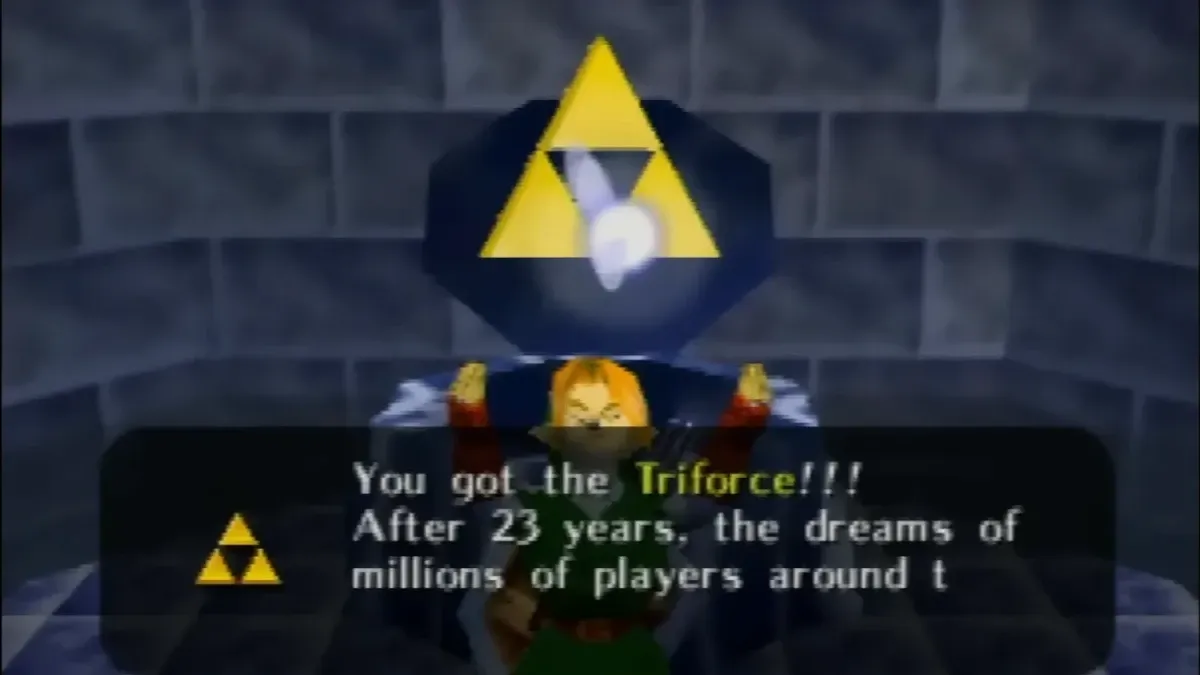
This is a story about the 1998 N64 original and a fan-made performance in 2022. It is not a method for obtaining the Triforce in normal play.
If I had to pick one performance that shows how much players can love a game, it would be this one, from the summer of 2022.
On the stage of Summer Games Done Quick, a charity speedrun marathon, sat a Nintendo 64 with an untouched cartridge of the 1998 Ocarina of Time in it. By the end of the show, Link had obtained the complete Triforce. Link and Zelda from Breath of the Wild were standing on screen. And messages that viewers had just typed into the livestream chat were floating across the sky.
Stop for a second and think about how little sense that makes. The N64 has no network port and no Wi-Fi, so how did it read the chat? The cartridge is read-only, so where did characters from a 2017 game come from?
You are probably thinking it must be a ROM hack, or a flash cart. The team expected exactly that, so they were very clear: the cartridge was an original US version 1.0, the console was a real N64, and the only modification was a passive RGB video mod that never touches game data.
So how was any of this possible? To answer that, we have to start with a lie that fooled Zelda fans around the world for over a month.
Why did everyone believe the Triforce was hidden in Ocarina of Time?
The Triforce is the heart of the Zelda series: three golden triangles for Power, Wisdom and Courage, said to grant the wish of whoever holds them. The story of Ocarina of Time revolves around it.
But when you actually finish the game, you find that it only ever exists in the story. Ganondorf seizes it, it splits into three, and Link only learns at the end that he carries one piece, Courage. The complete Triforce is never something you can hold.
And yet the clues seemed to be everywhere. Early promotional footage showed Link raising the whole Triforce above his head. Right in the middle of the game’s menu sits a Triforce-shaped emblem that looks exactly like an empty slot waiting to be filled. In an era when most players were not online yet and news traveled by word of mouth, a gap like that filled up with rumors fast.
The most famous one began in February 1999.
A player calling herself Ariana Almandoz, who said she was from Colombia, emailed a Zelda fan site claiming she had found the Triforce, and sent a screenshot of Link holding it. She refused to share the full method and released hints one at a time. The most important one: you first had to learn a hidden ocarina song called the “Overture of Sages.” Unlike Zelda’s Lullaby, it was not a song you could learn in the original game.
She kept the whole community hanging for more than a month. Then someone noticed that in her screenshots, Link’s sword was on the wrong side of his back. Link is left-handed. In March 1999, she admitted that the pictures were fake. The hidden quest had been a hoax.
The lie was exposed. But the wish to hold the Triforce did not go away. It stayed with players for more than twenty years.
What changed in 2019 that made the impossible possible?
The turning point was a glitch that looked tiny at first.
In October 2019, a player named GlitchesAndStuff noticed something odd. If you grabbed an object with the boomerang and then changed rooms, the object could turn into something else, like a door.
The speedrunning community jumped on it and soon worked out why. When you change rooms, the game deletes the object, but the boomerang still remembers where that object used to live in memory and keeps writing to that spot. If something else happens to move into that spot, the boomerang quietly changes it. The glitch became known as Stale Reference Manipulation, or SRM.
It sounds like a fun bug, but experienced players saw what it really meant. If you can control what gets written and where, you can make the game run instructions you wrote yourself. That is called arbitrary code execution, or ACE, and for people who study games it is about as powerful as a glitch gets. Less than a month later, in November 2019, ACE worked in Ocarina of Time for the first time.
The first thing speedrunners did with ACE was subtract. They jumped straight from the opening forest to the credits and shrank the whole game down to minutes. That made sense; speedrunning is about being fast.
But one group was thinking about something else. If ACE could cut the game down to minutes, could it also be used the other way, to add to it? Not to tear the game apart, but to give it a story it never had.
The person leading that idea goes by Sauraen. Over time he brought in programmers, artists, composers and even voice actors, more than 25 people in all. They spent about two and a half years and more than a thousand hours on a single goal: building the Triforce ending that fans had been promised by rumors for over two decades.
What did the audience actually see?
Summer 2022, SGDQ. The schedule gave this segment a modest name: “Ocarina of Time Beta Showcase.” It sounded like a tour of cut content still sitting on the cartridge, and that is what the audience expected.
On stage was a speedrunner named Savestate. For the first few minutes, he seemed to be running an ordinary speedrun, just a strange one. He walked back and forth through one short passage in Kokiri Forest, turned the camera, picked up a rock, walked away and came back.
Every one of those steps was planned. He was arranging the game’s memory piece by piece, then using a rock that the game had already deleted, but that Link was still carrying, to trigger SRM. Of the whole team, Savestate was the only one who could do this setup by hand, without any tools.
When the setup was done, he handed the controller to a robot next to him called TASBot. For about twenty seconds, Link twitched on the spot as if something had possessed him.
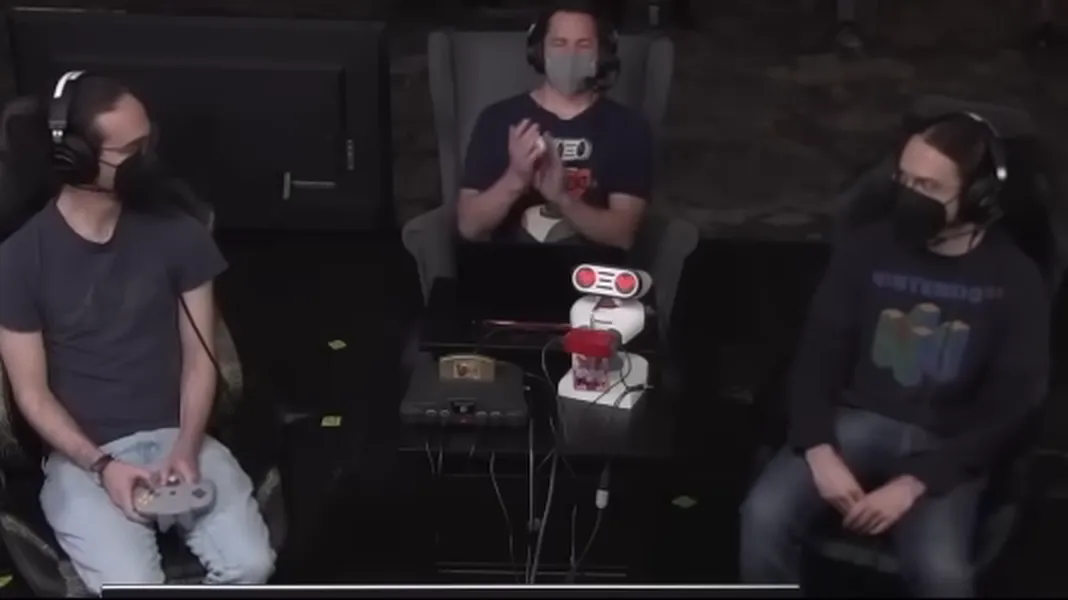
On stage: Savestate on the left with the controller, and TASBot, the little robot with red eyes, sitting next to a plain N64. The gold cartridge in it is an original 1998 Ocarina of Time.
Then strange things started to appear.
An Arwing from Star Fox flew into the forest.
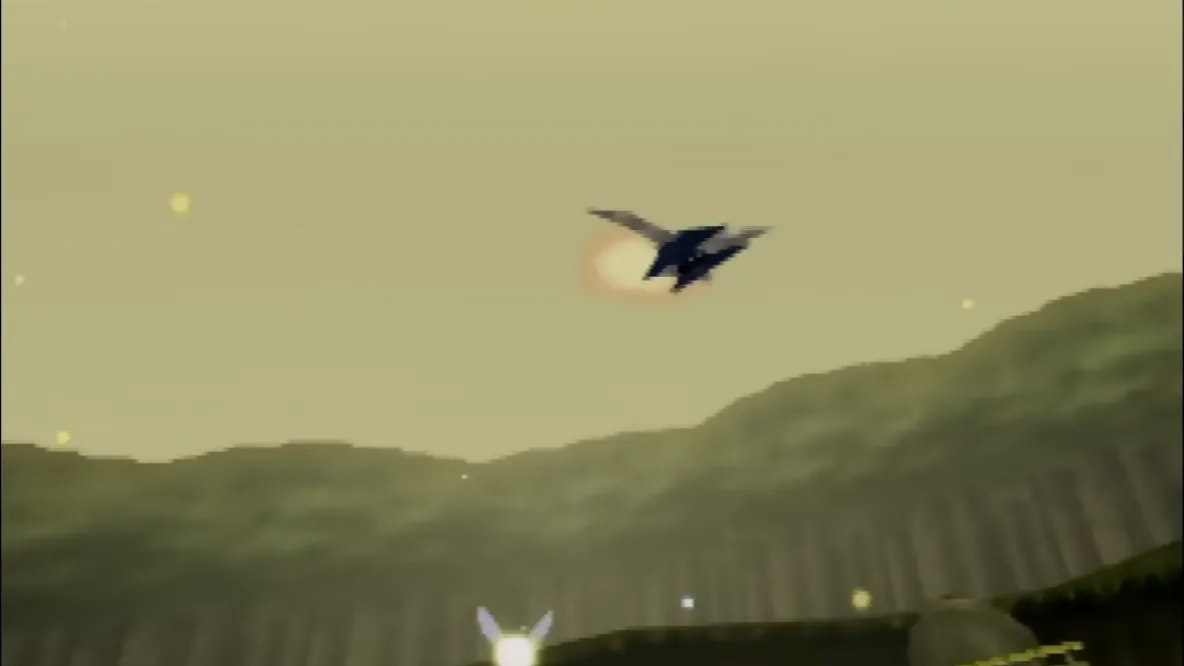
Yes, that is Fox McCloud’s ship, in Hyrule, with Navi watching from below. The model and its behavior are still sitting on every Ocarina of Time cartridge.
Longtime fans knew it: a test object left over from development, hidden in the cartridge’s code, never seen in normal play. Then came a beta Kokiri, a giant rupee that explodes when you touch it, and a beta Great Fairy. All of it was really on the cartridge, and none of it had ever shown up in the game as released.
After that, it stopped feeling like a showcase. Link went into the Lost Woods and raced the Running Man, the one who always beats you by a hair, and this time Link won. He entered a Unicorn Fountain that had only ever appeared in 1997 promotional screenshots, and there he learned a new song.
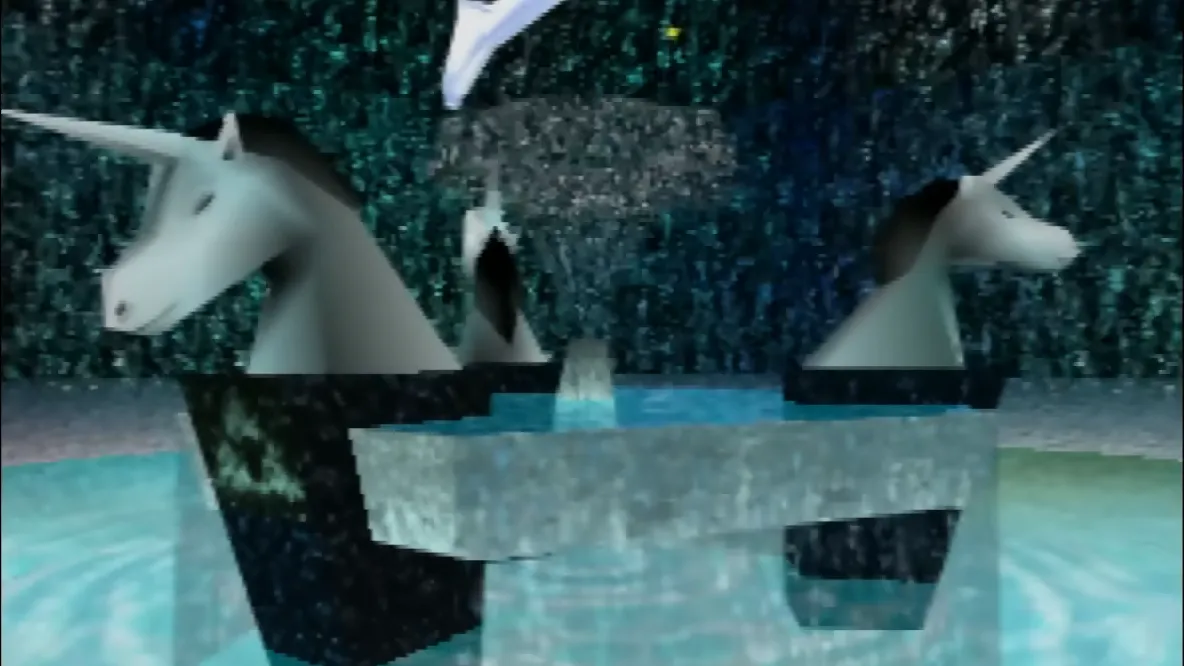
The Unicorn Fountain. This room from the 1997 screenshots never made it into the finished game. Triforce% finally let players walk into it.
A Great Fairy rose out of the water and said:
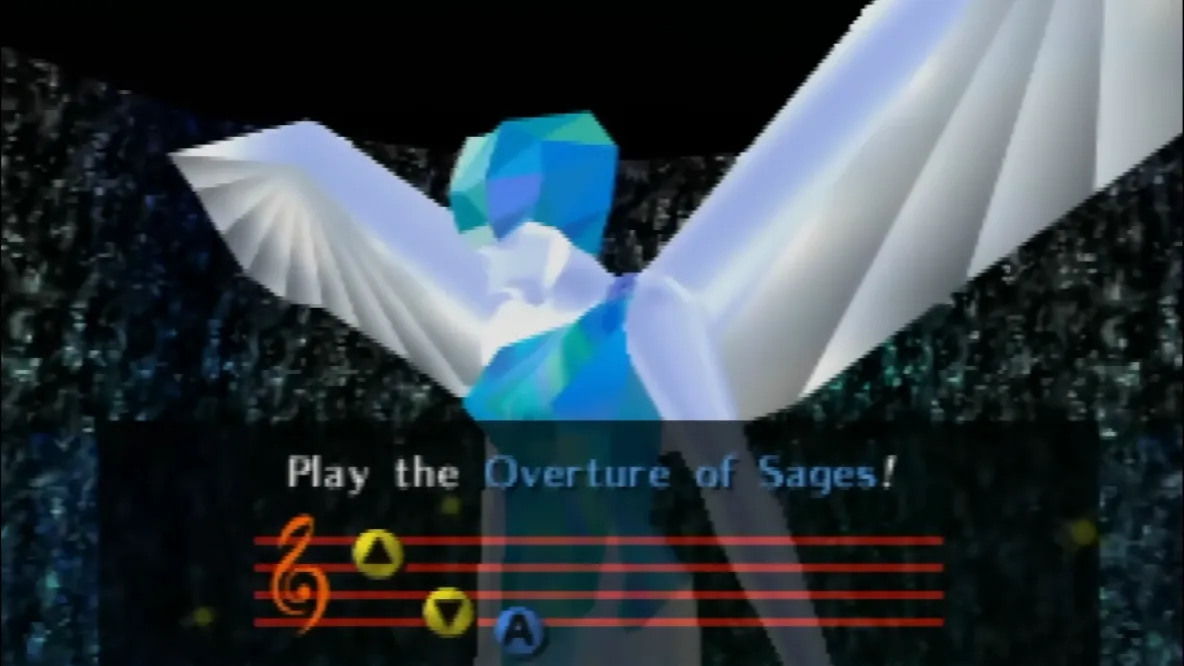
That song was the Overture of Sages, from the 1999 hoax. Six notes that someone made up to fool the internet:
▲ ▼ A ▶ ◀ ▲ A R L Y X A X R L A Y XMore than twenty years later, they were finally playing inside the game. You do not have to imagine what it sounded like. This is the moment from the live broadcast: the notes appear on the staff first, then Link plays them back. You will hear the commentators over it too.
Audio from the SGDQ 2022 broadcast, 23 seconds. If you want to play it yourself, open the ocarina simulator and press C-Up, C-Down, A, C-Right, C-Left, C-Up.
The team later listed where every single thing in the show came from: what was already on the cartridge, what they rebuilt from old promotional material, what came from fan legends, and what they wrote themselves. For the full history behind each legend, SwankyBox, one of the team’s partner creators, made a great video about it:

The lore behind the run: How Players Finally Obtained the Triforce (SwankyBox)
Wait, where did all that new content come from?
By now you might be feeling what the audience felt: something does not add up.
Even if ACE lets the game run any instruction, new scenes, new models, new music and voice acting are data. That data has to come from somewhere. It is not on the cartridge, and the console cannot go online.
The answer is the controllers.
The game stores controller input in memory: which buttons are pressed and where the stick is pointing. The team uses ACE to make the game execute instructions encoded in that input. A computer sends the carefully generated inputs through TASBot’s replay device and the controller ports.
Carefully arranged button signals can therefore carry code and data. For this performance, the controller ports become the road into the game.
That sounds wonderful, except that the road starts out incredibly narrow. The first code they can inject is only a small foothold; loading all the new scenes and models needs a more capable way to receive data.
So the team’s first move was not to send any content at all. With that tiny bandwidth, they wrote a small program that could receive data a little faster. Then they used it to load a faster one. Then they used that one to load a faster one still. The chain ends with the Hyperspeed Loader, which receives the custom content through controller input and writes it into the console’s Expansion Pak memory.
In other words, inside a 1998 console, using nothing but button signals, they paved a road and kept widening it. Those twenty seconds of Link twitching were the paving.
Once the road was ready, Savestate took controller one back and played normally, while TASBot used the other three ports to keep streaming new content into the console’s memory. How fast is that? In the team’s own words, you could do it too, if you were “a superhuman with 12 arms who can accurately press buttons on four controllers 480 times per second.”
One more thing worth knowing: the cartridge itself never changed by a single bit. Everything new lived only in the console’s memory. Turn off the power, and it is all gone.
If you want the full technical details, memory addresses and assembly included, the team recommends this breakdown from Retro Game Mechanics Explained:

Technical breakdown: Triforce Percent Explained (Retro Game Mechanics Explained)
What did Link wish for once he had the Triforce?
After a string of brand-new story scenes, Link finally opened the Triforce chest, in a room that had only ever appeared in 1997 promotional footage.
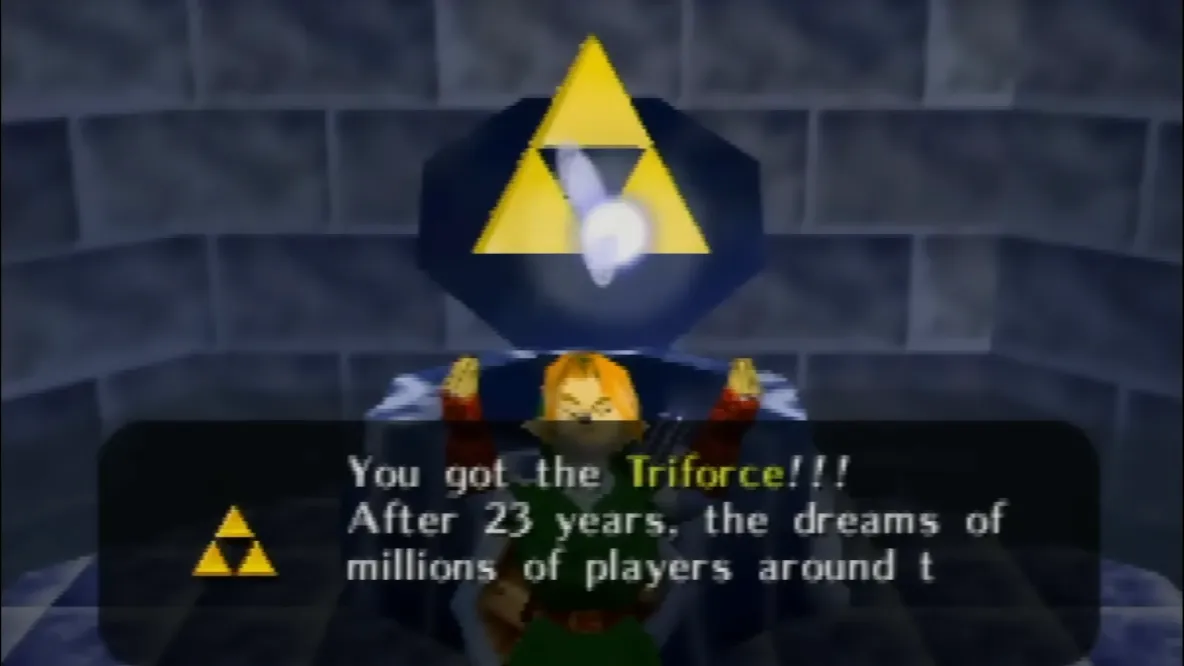
“You got the Triforce!!! After 23 years, the dreams of millions of players around the world…” The team wrote that line into the item text box, where you would normally read “You got the Boomerang!”
That is when the show’s real name was revealed. It was never a “Beta Showcase”; that title was cover so nobody would see the ending coming. Its real name was Triforce%: a run whose goal is getting the Triforce.
In Hyrule’s legends, the Triforce grants its holder one wish. So the game asked, in a plain dialogue box, like it was asking whether you wanted to buy a Deku Shield:
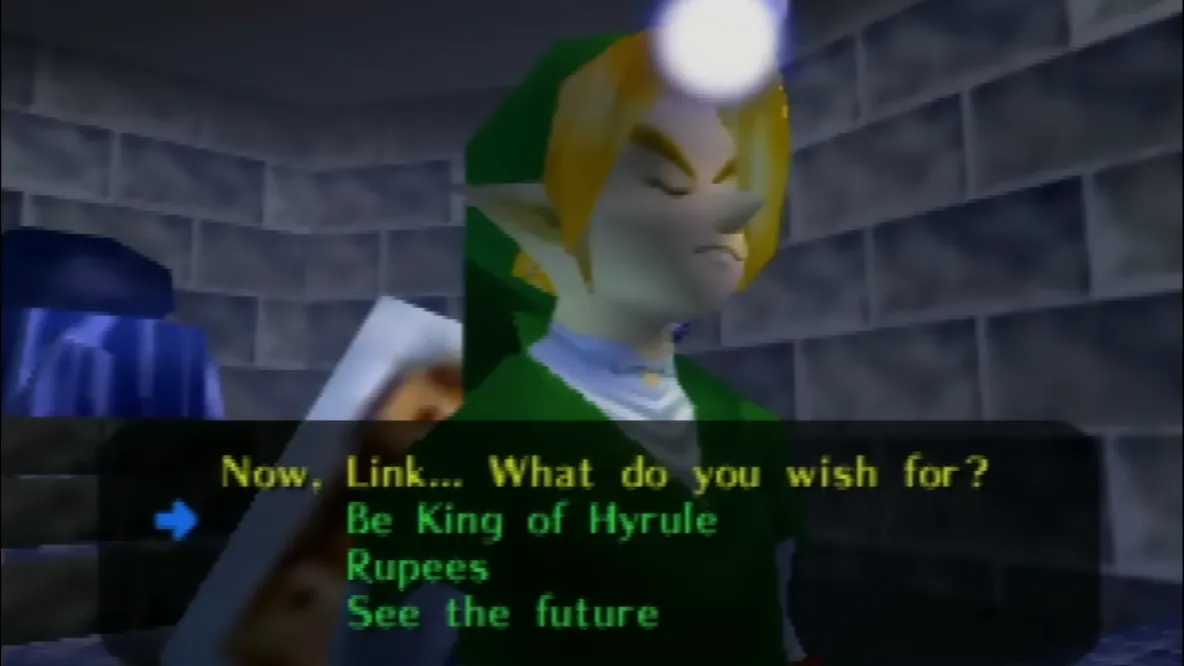
Be King of Hyrule. Rupees. See the future. Link’s wish was to see the future.
The scene changed. Standing there was no longer the silent Link from 1998, but Link from Breath of the Wild, with Zelda beside him. The cel-shaded models, the new animation and the full voice acting were all made by the team, and all of it arrived through the controllers, piece by piece.
Link even spoke, in Japanese. The team explained that the Japanese version of Breath of the Wild comes closer to giving Link a voice, and that his shouts have been performed by Japanese voice actors ever since Ocarina of Time.
Then lines of text began to appear in the sky. They were real messages that viewers had just typed into the SGDQ livestream chat, filtered by a script and sent into the game through the controllers in real time. A 1998 console with no way to go online was suddenly connected to thousands of people watching from home.
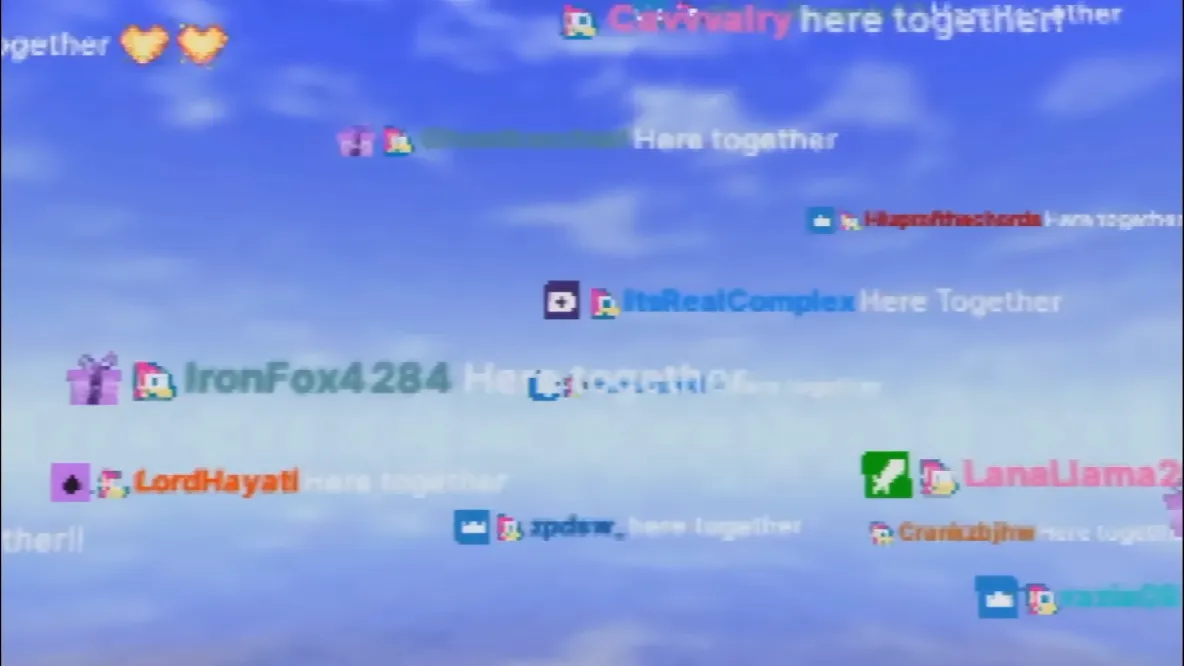
Many viewers typed the same two words: “here together.” Every username in that sky belongs to a real person who was watching at that moment.
Zelda tells Link: “You asked to see our future. Here it is.”
I do not want to explain this part any further. If you only watch one video, watch this one:

The full Triforce% performance at SGDQ 2022
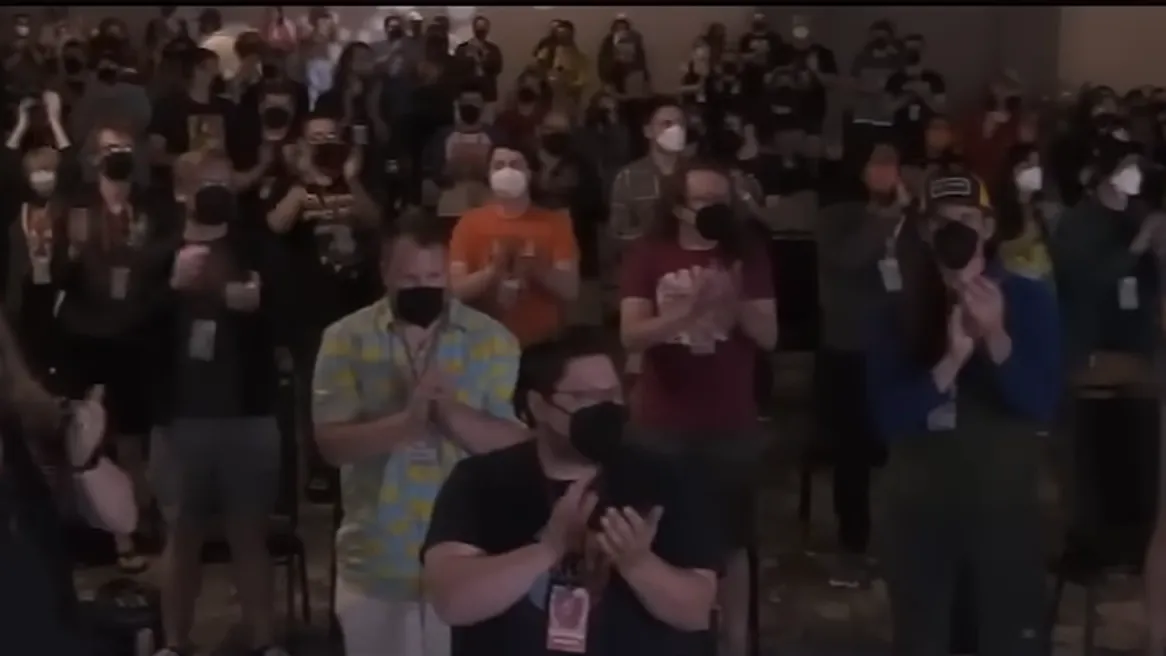
When the run ended, the camera turned to the room. Almost everyone was on their feet.
Why spend two and a half years on something you can’t sell?
If you only count practical value, this project has almost none.
The team does not distribute Nintendo’s ROM or copyrighted assets. It released its own tools, code and art, with partial builds available through the toolchain; that public release cannot reproduce the full showcase on its own. Nor was the showcase designed as a complete game to explore freely. What the team did bring to SGDQ was a live performance that, according to its official site, raised over $227,000 for Doctors Without Borders.
But look back over the whole story and you see that it answers a very old disappointment.
In 1999, one player fooled the world for a month with a fake screenshot and a song that did not exist. More than twenty years later, a group of fans used the game’s own glitches to make that fake song real, and to fill the empty slot in the middle of the menu.
Asked whether the Triforce can really be obtained in Ocarina of Time, the team answered: “It is now!”
And once they finally held the power to make the game do anything at all, they did not use it to break a record. They used it to bring thousands of strangers from a livestream chat into the same Hyrule sky.
Does any of this matter for the Switch 2 remake?
This demonstration was built for the original US N64 version 1.0. It does not establish that the same exploit works in another version, and it is not a remake walkthrough.
What carries over is the passion around the game. For almost three decades, players have kept taking Ocarina of Time apart, studying it and reimagining it, and that is part of why its remake matters so much. For the story the game really tells, read our Ocarina of Time story recap. For the twelve ocarina songs that actually exist, see the ocarina songs overview. For what Nintendo changed in the new version, see remake vs N64 changes.
Where can I learn more?
These are the sources for this article. All are free:
- Triforce% project homepage, the team’s overview and fundraising total
- Triforce% official site and FAQ, the team’s own answers, including the full list of real and invented content
- Retro Game Mechanics Explained: Triforce Percent Explained, the full technical breakdown of SRM and the loaders
- TASVideos publication of Triforce%, the official record of the run with the team’s notes
- Kotaku on the 1999 Triforce hoax
- Ars Technica coverage from July 2022
Triforce% was directed by Sauraen, with Savestate as the speedrunner and dwangoAC as executive producer, alongside a credits list of more than 25 contributors. The screenshots and the audio clip on this page come from the Summer Games Done Quick 2022 broadcast of the run.
FAQ
Was Triforce% done on a modified cartridge or an emulator?
Can you really get the Triforce in Ocarina of Time?
Is the Overture of Sages a real ocarina song?
Could a human do Triforce% without TASBot?
Does Triforce% work on the Switch 2 remake?
Related Articles
guides
Ocarina of Time Remake vs N64: Every Change Spotted So Far
Every confirmed and trailer-spotted change in the Ocarina of Time Switch 2 remake compared with the 1998 N64 original, from jumping to Threads of Time.
guides
Ocarina of Time Story Recap: The Original Plot Before the Remake
A full Ocarina of Time story recap of the 1998 original, from the Great Deku Tree to the final battle with Ganon, plus what the remake changes for returning players.
guides
How to Get Epona in Ocarina of Time Remake
Get Epona in the Switch 2 remake: learn the song, bring 40 Rupees, win both Ingo races and jump out of Lon Lon Ranch, with existing illustrated steps.
Was this helpful?
Thanks for the feedback!